AMD is a multifactorial, degenerative eye disease and a major cause of blindness among the elderly worldwide. Late stage, dry form of AMD (geographic atrophy, GA), is characterized by high drusen load with slow deterioration of the RPE and subsequent loss of the photoreceptor cell, resulting in irreversible blindness. Currently, antioxidant vitamins and zinc supplements are suggested to slow disease progression, but do not stop vision loss, and does not work for all patients with dry AMD. Our recent work suggests that RPE loss in GA is induced by the activation of the inflammasome, a cytoplasmic receptor complex that senses intracellular stress signals and causes pyroptosis, a caspase 1-dependent form of cell death.
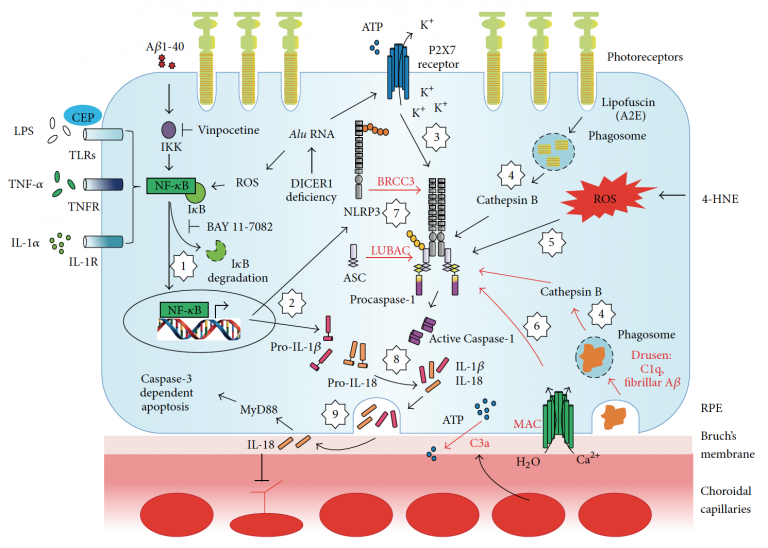
Gao et al., NLRP3 Inflammasome: Activation and Regulation in Age-related Macular Degeneration. Mediators of Inflammation 2015, Article ID 690243 (http://dx.doi.org/10.1155/2015/690243)
This project will focus on a gene treatment to bolster levels of X-chromosome linked inhibitor of apoptosis protein (XIAP), an experimental neuroprotective agent for photoreceptors in retinal dystrophies. A recent important finding is that XIAP, well known for its ability to suppress caspase-3 dependent apoptosis, regulates and inhibits inflammasome activity. We propose to bolster protein levels of XIAP by gene therapy in vitro and in vivo to identify the dual mechanisms of XIAP rescue of RPE. The broad goal of this research project is to prevent blindness in age-related macular degeneration (AMD) by development of a novel method to limit inflammation-induced atrophy of the retinal pigment epithelium (RPE) in the eye.
AMD is a complex, multifactorial disease and a major cause of blindness among the elderly worldwide. The more common ‘dry’ form accounts for over 90% of AMD, and is characterized by drusen, extracellular deposits of unwanted cell debris located near the RPE. Drusen become larger and more numerous during dry AMD progression, culminating in geographic atrophy (GA), in which RPE and photoreceptors die, resulting in blindness. Genetic factors play an important role in AMD development. Namely, complement factor H gene variants are strongly associated with increased risk of AMD.
Preliminary gene and protein studies suggest that RPE genotyped with the CFH risk variant demonstrate reduced levels of (inhibitory) complement regulators that promote cellular deposition of membrane attack complex (MAC, complement cascade end-product). Here, we test the role of MAC on inflammasome activation, a cytoplasmic receptor complex that is deemed to play a role in chronic inflammation and AMD development. How MAC alone, or in combination with drusen components (e.g. amyloid beta), promotes inflammasome activation in RPE is unknown. Results will inform on the genotype-specificity of the cellular mechanisms associated with the pro-inflammatory cascades that contribute to RPE dysfunction associated with GA in AMD.
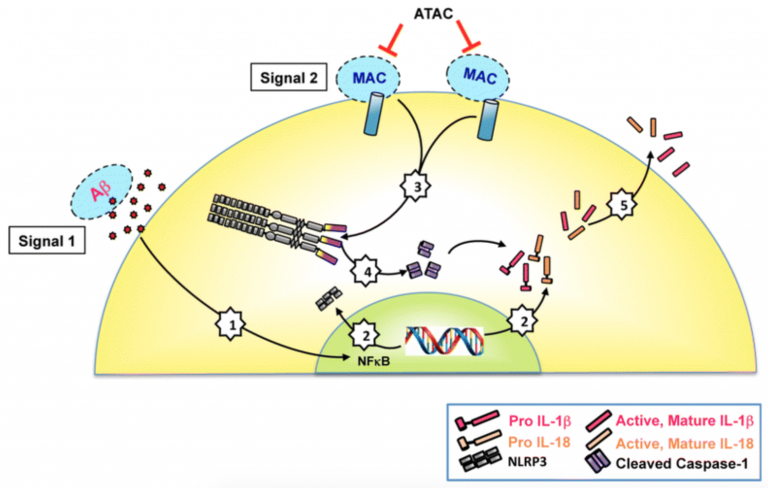
Proposed inflammasome activation mechanisms with Aβ and MAC in RPE/choroid (Zhao et al., Age-related Increases in Amyloid Beta and Membrane Attack Complex: evidence of inflammasome activation in the rodent eye. Journal of Neuroinflammation 2015, 12:121 (DOI: 10.1186/s12974-015-0337-1)
The goal of our work is to prevent chronic inflammation, an important initiating trigger in age-related macular degeneration (AMD) pathogenesis. To achieve this goal, we will identify the cellular interactions between the complement system and inflammasome activation in retinal pigment epithelial (RPE) cells genotyped for complement factor H (CFH) gene variants.
Age-related macular degeneration (AMD) is the leading cause of irreversible blindness in the elderly. Unfortunately, current treatments only exist for the advanced form of AMD and begin after significant eye damage has already occurred. Chronic inflammation and abnormal formation of new blood vessels play a significant role in this complex multifactorial disease. Our proposal will focus on special enzymes, called proteases that shape the cellular environment in the retina. Abnormal activation of these proteases can cause inflammation by releasing harmful molecules such as tumor necrosis factor (TNF) in the eye. Our group has developed a way to use the proteases so that instead of harmful factors, they release therapeutic factors. It is important that the therapeutic factor is only released when it is needed to minimize any potential side effects in the retina The long term goal of this novel and first-in-class strategy is to have the retinal cells release the engineered therapeutic factors only at the site of inflammation and injury, in timely manner, and only when the injurious processes have reached a certain critical threshold. Our proposed "smart" therapeutic strategy will be positioned in retinal cells in advance of disease, and work as needed to reduce the negative systemic and off-target effects frequently associated with current therapies for eye disease.
Traumatic eye injury is one of the leading causes of monocular blindness worldwide. This profound and frequently irreversible posttraumatic loss of vision has a poor prognosis due to retinal cell death, scar formation, and lack of functional regeneration. Proliferative vitreoretinopathy (PVR), a form of intraocular fibrosis, is often the primary reason for the loss of vision after ocular trauma, and frequently occurs after blunt trauma and open globe injuries caused by penetration, rupture, perforation, and presence of intraocular foreign bodies as well as after retinal re-attachment surgery. PVR is a complex cellular process initiated by inflammation, ischemia, and hemorrhage within the vitreous cavity. These events trigger the migration, and proliferation of inflammatory cells in the retina, including the retinal pigment epithelium and glia which then contribute to the formation of epiretinal membranes which contract and separate the retina from the RPE thus causing retinal tears, degeneration and gliosis with disastrous consequences for vision. Many of these pathological events can be traced to the local pro-inflammatory processes that trigger several downstream mechanisms including the activation of metalloproteinases (MMP), that facilitate extracellular matrix (ECM) remodeling. The inflammation-induced MMP have also been shown to participate in the shedding of various transmembrane proteins in the CNS including receptors, adhesion molecules, growth factors, and cytokines.
Our group will use an innovative strategy to genetically engineer transmembrane proteins ready to release their anti-inflammatory, anti-proliferative and neuroprotective ectodomains by extracellular proteases activated under adverse conditions induced by traumatic eye injury. We hypothesize that, once inserted into the cell membrane of retinal cells, these “protease activity sensors” will be activated by traumatic injury-induced inflammatory events to release “therapeutic ectodomains”. We propose here to exploit the released ectodomains to avert the pathological cascade that leads to irreversible loss of vision in PVR.
One of the biological hallmarks of Alzheimer's Disease (AD) is the abnormal deposit of amyloid beta in brain tissues, and recently we have identified that this also occurs in the retina. This study will utilize transgenic mouse models of AD to investigate the relationship of amyloid beta buildup in the brain and eye. By quantifying the ratio of amyloid beta plaques in the brain with deposits in the eye at different ages, we will obtain important information to estimate the relative plaque load in the brain based on the measurements obtained in the eye.
Next, preclinical studies of post-mortem eye tissues from AD, non-AD dementias, and age matched control donors will be undertaken in the whole mount preparation and will provide us with measurements of amyloid beta deposits in the AD eye, and its relationship with amyloid beta plaque load in the brain.
We will use the endogenous fluorescence of curcumin, a natural and safe fluorochrome that has a high affinity to a amyloid beta plaques, to label amyloid beta deposits in the eye towards the development of specialized fluorescent imaging equipment for ocular amyloid beta deposits. Our non-invasive optical imaging technology will continue to undergo development towards improving our understanding of the disease mechanisms and accelerate the development of therapeutics. The optical imaging and computational anatomy technology tools developed here can additionally be used to investigate the role of amyloid beta in other important age related diseases (such as age related macular degeneration, AMD, and glaucoma), as well as for the development of additional biomarkers for future studies for AD.
Granzyme B (GzmB) is a serine protease that acts like a molecular scissor, capable of cutting structural proteins outside cells. While this activity is important in immune defense, excessive or misdirected GzmB can weaken tissue barriers, drive chronic inflammation, and promote abnormal wound healing (i.e. abnormal blood vessel growth and scar tissue formation).
In 2020, our lab became the first to investigate GzmB in the eye. Vision depends on the health of the retina and a thin, specialized barrier beneath it called Bruch’s membrane (BM). BM forms the outer blood–retinal barrier (oBRB), supporting both the photoreceptor–retinal pigment epithelium (RPE) unit and the underlying choroidal blood vessels. With aging, BM undergoes structural changes and becomes increasingly vulnerable to inflammatory and proteolytic damage. These changes contribute to the major features of age-related macular degeneration (AMD): 1) early drusen deposits, RPE dysfunction and photoreceptor cell death in dry AMD, and 2) abnormal blood vessel growth (termed choroidal neovascularization) and scar tissue formation (termed subretinal fibrosis) in wet AMD.
Our research explores the hypothesis that GzmB is a key upstream driver of these pathological changes. We are investigating how GzmB-mediated cleavage of extracellular and junctional proteins may:
1) Initiate early AMD by disrupting RPE tight junctions, increasing oBRB permeability, accelerating BM remodeling, and ultimately contributing to RPE atrophy and photoreceptor loss
2) Promote late-stage wet AMD by releasing sequestered inflammatory and angiogenic factors, enabling choroidal neovascularization (CNV), and driving the angiofibrotic switch that leads to subretinal fibrosis.
To test this hypothesis across multiple biological systems, we use a combination of in vivo, ex vivo, and in vitro approaches:
- A) Laser-induced CNV model: We use the standard laser photocoagulation model to induce CNV and have shown that GzmB deficiency significantly reduces lesion size and vascular leakage.
- B) Two-stage laser model of subretinal fibrosis: Using sequential laser injury, we demonstrate that GzmB contributes to the development and severity of subretinal fibrotic lesions.
- C) Choroidal sprouting assay: GzmB enhances angiogenic sprouting ex vivo, while its inhibition suppresses choroidal outgrowth
- D) ARPE-19 scratch assay: GzmB impairs RPE wound closure, consistent with its ability to cleave tight junctional and extracellular matrix proteins
Together, these findings position GzmB as a central contributor of barrier breakdown, inflammation, angiogenesis, and fibrosis in AMD. Building on this foundation, our current work explores GzmB inhibition as a therapeutic strategy. By blocking GzmB activity, we aim to preserve oBRB integrity, reduce inflammatory and angiogenic signaling, protect photoreceptors, and prevent both CNV and subretinal fibrosis, ultimately slowing or halting the progression of AMD.

Unlocking the genetic mystery of age-related macular degeneration
Age-related macular degeneration (AMD) is a leading cause of vision loss. While researchers have long known that a specific genetic variation significantly increases a person's risk of developing AMD, the exact reason why this gene leads to eye damage remains a mystery. Our research identifies the missing link: a protein called Granzyme B. We discovered that even in people who have the high-risk gene but do not yet have clinical signs of AMD, an overactive immune system triggers the release of Granzyme B at the back of the eye. This protein essentially acts like molecular scissors, chopping up vitronectin, a crucial structural support and protective layer. When this protective barrier breaks down, the delicate retinal tissue becomes stressed and damaged. By identifying Granzyme B as a primary driver of this early tissue breakdown, our work explains how the genetic risk translates into physical damage and highlights a promising new target for therapies aimed at stopping AMD in its earliest stages.

Extracellular Granzyme B bridges CFH Genetic Risk and Early AMD Pathogenesis
The complement factor H (CFH) Y402H polymorphism is a well-established genetic risk factor for age-related macular degeneration (AMD). However, the molecular mechanisms that translate systemic complement dysregulation into localized retinal tissue injury have lacked a definitive mediator. Our study identifies extracellular granzyme B (GzmB) as the critical link driving this structural pathology.
Key Findings:
- Clinical Correlation: Patients with dry AMD exhibit significantly elevated levels of plasma GzmB.
- Human Donor Pathology: In clinically normal human donor eyes (without clinical AMD), the high-risk CFH genotype is already associated with an increase in GzmB-positive choroidal mast cells and enhanced membrane attack complex (MAC) deposition.This is accompanied by a pathogenic redistribution of vitronectin (a terminal complement inhibitor and structural matrix protein), characterized by loss in the inner choroid and abnormal sub-RPE accumulation.
- Mechanism of Barrier Disruption: In vitro assays demonstrate that complement fragment C5a triggers GzmB secretion and pro-inflammatory signaling in RPE cells, directly leading to zonula occludens-1 (ZO-1) disruption. RNA sequencing confirms distinct transcriptomic signatures of cellular stress and blood-retinal barrier dysfunction.
- In Vivo Validation: GzmB-deficient mice exhibit preserved choroidal vitronectin compared to wild-type controls, confirming GzmB's role in the proteolytic cleavage of this extracellular matrix component.
Conclusion: These findings delineate a novel, neuroinflammatory pathway that compromises extracellular matrix integrity and outer blood-retinal barrier function. This establishes extracellular GzmB as a vital mechanistic bridge between genetic complement risk and the onset of early AMD neurodegeneration.